-
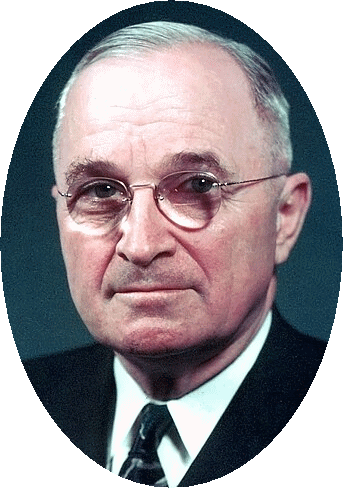 President of the United States: Harry S. Truman - 33rd president serving
from 1945 to 1953 President of the United States: Harry S. Truman - 33rd president serving
from 1945 to 1953
-
Vice President: Vacant
-
Average annual household income: $2,500
-
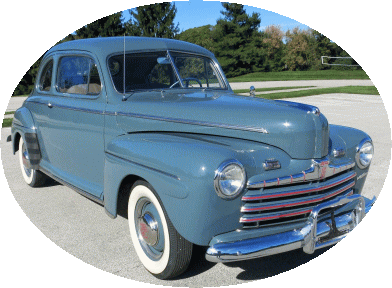
Average cost of a new car: $1,120
-
Average cost of a new home: $5,600
-
Average monthly rent: $60.00
-
Average retail price for a gallon of gas: 15 cents
-
Cost of a first-class stamp: Three cents
-
Inflation rate: 8.33 percent
-
Minimum wage: 40 cents/hour
-
Unemployment rate: 3.9 percent
-
In 1946, a gallon of milk cost 67 cents, eggs were 59 cents a dozen, and a loaf
of white bread was 10 cents. A movie ticket cost 25 cents,
a cup of coffee was 22 cents, and fresh chicken pot pies were 43 cents
apiece.
-
American companies and brands established in 1946 included Avis Car Rental, Best Western Hotels & Resorts, Estee Lauder,
Fidelity Investments,
Iams pet foods, and the Tupperware Corporation.
-
Consumer products launched during the year included Almond Joy candy bars, Benadryl, the food processor, the Osterizer,
Tide laundry detergent,
and Tupperware.
-
Between 1946 and 1964, the United States had over 76 million births. Consequently, a “baby boomer”
is defined as anyone born during the
18 years after World War II, when there was a significant rise in the U.S.
birth rate. Indeed.com tells us that baby boomers
“have a strong and focused work ethic. They are typically hard-working
individuals who often define themselves by their professional accomplishments.”
Famous boomers from across the globe include Barack Obama, Bill Clinton, Bill Gates, Chris Evert, Diana Spencer, Dolly Parton, Donald Trump,
George W. Bush, Jack Ma, Jeff Bezos, Madonna, Michael Jackson, Michael
Jordan, Oprah Winfrey, Steve Jobs, and Wayne Gretzky.
-
On January 10, the first meeting of the United Nations General Assembly, initially composed
of 51 nations, took place in London.
-
On January 22, President Truman established the Central Intelligence Group (CIG), the
“operational extension” of the National Intelligence Authority.
The CIG was renamed the CIA in 1947.
-
On February 14, the University of Pennsylvania in Philadelphia unveiled the ENIAC (Electronic
Numerical Integrator and Computer),
the first “general-purpose electronic computer.”
-
On March 5, at a speech in Fulton, Missouri, British statesman Winston Churchill
spoke about the Iron Curtain —”a political boundary that divided
Europe into two separate areas from the end of World War II in 1945 until
the end of the Cold War in 1991.”
Churchill’s famous speech warned Americans about the potential of Soviet
expansion throughout the world.
-
On March 7, at the 18th Academy Awards, The Lost Weekend won four Oscars, including Best Picture, Best Director, Best Actor, and
Best Screenplay.
-
Between May 2 and 4, the Battle of Alcatraz took place at the Alcatraz Federal Penitentiary in the San Francisco Bay. HistoryExtra.com reports that
“several prisoners held at Alcatraz Federal Penitentiary enacted a plan
to escape the island prison. The ensuing 48-hour siege was the most violent
in the prison’s history, resulting in five deaths and more than a dozen
injuries.”
-
On May 11, the first 15,000 CARE (Cooperative for American Remittances to Europe)
packages, “containing surplus food from the U.S. Army,
arrived at the port of Le Havre, France.” The NationalWW2Museum.org reports
that “These packages were sent to survivors of World War II in Europe
to address the severe food shortages caused by the war.”
-
On June 3, eleven MLB players were inducted into the Baseball Hall of Fame. They were Jesse Burkett, Frank Chance, Jack Chesbro, Johnny Evers,
Clark Griffith, Tommy McCarthy, Joe McGinnity, Eddie Plank, Joe Tinker,
Rube Waddell, and Ed Walsh.
-
On June 4, President Truman signed the National School Lunch Act into law. The bill
provides low-cost or free lunches to eligible children
each school day through subsidies to schools.
-
On July 4, the United States granted the Philippines their independence.
-
On June 6, the Basketball Association of America (BAA) was formed in New York City.
The BAA was later renamed the National Basketball Association (NBA),
which is now composed of 30 teams in the U.S. and Canada. Some of the current
NBA teams are the Atlanta Hawks, Boston Celtics, Chicago Bulls,
Cleveland Cavaliers, Denver Nuggets, Golden State Warriors, Los Angeles
Lakers, New York Knicks, Philadelphia 76ers, and Toronto Raptors.
-
On July 7, Mother Frances Xavier Cabrini became the first American to be canonized
as a saint by the Roman Catholic Church.
-
On July 14, Dr. Benjamin Spock’s classic—The Common Sense Book of Baby and Child Care—was published. ThoughtCo.com remarks that the book
“completely changed how children were raised in the latter half of the
20th century” and also became one of “the best-selling non-fiction books
of all time.”
-
On August 1, President Truman signed the Atomic Energy Act of 1946 into law, which
established the United States Atomic Energy Commission.
-
On September 15, the DuMont Television Network, one of America’s pioneer commercial TV networks, began regular broadcasting.
DuMont’s first two channels in the U.S. were WABD in New York City and
WTTG in Washington, DC.
-
On November 6, during the midterm elections, Republicans gained 55 House seats and 12
Senate seats, enough to give them control of both houses of
Congress for the first time since 1928.
-
On November 12, an Exchange National Bank branch in Chicago’s Loop opened the first drive-up teller window.
-
From November 25 to December 27: Over 1,000 public school teachers in St. Paul, Minnesota, went on strike,
demanding better working conditions,
higher pay, smaller class sizes, and improved textbooks. It was the first
organized teachers’ strike in U.S. history and established a precedent
for collective bargaining.
-
On December 14, U.S. Secretary of State James Byrnes offered Denmark $100 million in
gold bullion (about $1 billion today) to buy Greenland.
However, Denmark did not agree to sell.
-
On December 26, mobster Bugsy Siegel opened the glitzy Flamingo Hotel & Casino on the Las Vegas Strip.
-
On December 31, President Truman issued a presidential proclamation that declared an official end to World War II. Proclamation 2714 stated,
“Now, THEREFORE, I, HARRY S. TRUMAN, President of the United States of America, do hereby proclaim the cessation of hostilities of World War II,
effective twelve o’clock noon, December 31, 1946.”
-
In 1946, Fibber Magee & Molly was the most popular radio program, Song of the South was the most popular film, and The King’s General
was the most popular fiction book.
-
Famous people born during 1946 included Bill Clinton, Candice Bergen, Dianne Keaton, Dolly Parton, Donald Trump, George W. Bush, Linda Ronstadt,
Sally Field, and Steven Spielberg.
-
Here are some sports facts from 1946: The Chicago Bears were the NFL champs, the St. Louis Cardinals won their
sixth World Series title,
and the Montreal Canadiens clinched the Stanley Cup.
-
In 1946 as well, the words big rig, Caesar salad, captain’s chair, deejay, digital computer,
dry sink, entry-level, freeze-dried, ground zero, key lime pie,
Latino, Shirley Temple, split-level, step stool, and welcome mat all appeared
in print for the first time.
|